 Online knowledge test
Road safety
Micromobility vehicles
Micromobility refers to small, lightweight personal vehicles used for short trips. They include e-bikes, e-scooters, mini motorcycles, and other low-powered vehicles like hoverboards, electric skateboards and electric unicycles.
As more people use micromobility across British Columbia, roads and paths are being shared in new ways. While micromobility can help reduce traffic and pollution, it can also create safety challenges. Many roads were designed for motor vehicles, not for different types of road users moving at different speeds. People using micromobility are often most vulnerable in a crash.
Find out how to ride safely and legally.
Micromobility: summary of road rules
Where can I ride? | What's the minimum age? | How fast can I go? | Licence and insurance? | What else should I know? | |
|---|---|---|---|---|---|
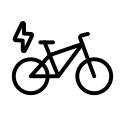
| Anywhere cyclists can ride | Light e-bikes: 14+ Standard (full power) e-bikes: 16+ | Light e-bikes: 25 km/h Standard e-bikes: 32 km/h | No driver's licence or insurance required | Must have fully operable pedals |
| Only in participating communities (pilot program) | 16+ | 25 km/h | No driver's licence or insurance required | Illegal outside of pilot communities |
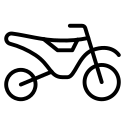
| Not on public roads, sidewalks or bike lanes | Not legal at any age on public roads | Not allowed on public roads | Cannot be registered or insured | Can import for closed-course racing |
E-skateboards; other micromobility | Not on public roads, sidewalks or bike lanes | Not legal at any age on public roads | Not allowed on public roads | Cannot be registered or insured | Do not meet safety standards |



Not all micromobility vehicles are legal for use on public roads in B.C.
To learn more, visit the B.C. government page about emerging modes of personal transportation.
What ICBC is doing to improve road safety
Providing safety information and education. ICBC road safety coordinators work with police, municipalities, transit authorities, and community safety volunteers to educate drivers and micromobility users about the rules of the road and safe, shared road use.
Investing in safer roads. ICBC contributes toward community road safety and infrastructure improvements that help protect micromobility users and other vulnerable road users. Since 1990, we’ve partnered on more than 9,000 road improvement projects across B.C., including $780,000 invested in cyclist safety and $4 million in 300 pedestrian safety improvements over the past five years (2020-2024).
Supporting research and data sharing. We work with police, road authorities and government partners to use crash data and share insights that identify high‑risk locations and support safer road design and injury prevention (Statistics).
Covering riders when a motor vehicle collision occurs. ICBC pays Enhanced Accident Benefits with no overall limit to all B.C. residents injured in a crash. This includes drivers, passengers, cyclists, and pedestrians.
ICBC does not
Set laws or enforce rules. ICBC’s role is to support safety as micromobility becomes a more established part of B.C.’s transportation system.
License or insure micromobility devices. ICBC can only license and insure vehicles if they meet provincial vehicle safety standards for unrestricted on-highway use.
Approve device designs or safety standards. Retail availability can give the impression that these devices are regulated, which isn’t always the case. We encourage parents and riders to learn how these devices are meant to be used, where they’re allowed, and what protective equipment is recommended or required.

